Quick Answers
- What is it? Khan Academy PreK Assessments are short, bilingual, tablet-based direct assessments for children ages 3–5.
- How long does it take? About 5-7 minutes per child per skill.
- What does it measure? Math, literacy, receptive language, and executive function.
- How is it different from TS GOLD or DRDP? Children demonstrate skills by answering questions directly on a tablet rather than being rated by an observer, reducing the burden on teachers and bias that can sneak its way into written observations.
- Does it replace my existing observational assessment tool? No. All skills can not be assessed directly and require direct observation. For this reason, the Khan Academy PreK Assessments are designed to be used alongside your existing observational assessment tool; reducing the number of skills needed to be observed and increasing data accuracy.
- Is it free? Yes. Free for eligible publicly funded PreK programs during SY 2026–27 and SY 2027–28.
Every fall, PreK teachers across the country do the same thing: they pick up their clipboards and tablets, open their observation platforms, and start the months-long process of trying to catch kids in the right moments—writing anecdotal notes, tagging behaviors, documenting observable moments—so they can eventually submit the data their programs require.
It’s exhausting. And for a lot of programs, it’s not even producing reliable data.
That tension—between the real burden of observational assessment and the genuine need for high-quality kindergarten readiness data—is what led us to build Khan Academy Early Childhood Assessments. Today, we’re excited to share that these new PreK assessments are available as part of Khan Academy Kids for Schools, and that publicly funded PreK programs can access it free for SY 2026–27 and SY 2027–28 as part of our pilot launch.
The Limits of Observational PreK Assessment (TS GOLD, DRDP, COR Advantage)
Observation-based tools like TS GOLD, DRDP, and COR Advantage are the backbone of PreK assessment in most publicly funded programs. They’re deeply embedded in Head Start requirements, state funding systems, and teacher workflows, and there are good reasons they’ve persisted.
But spend any time in PreK classrooms and you hear the same concern: teachers are shaping lessons around what’s observable rather than what children need — and the data still isn’t reliable. Evidence-gathering becomes a sprint at the end of each marking period. Data quality varies widely depending on who’s doing the observing, what opportunities students happened to have that month, and how much time teachers had to capture it all.
Research backs this up. Observational ratings are subject to rater bias, inconsistent evidence collection, and the simple reality that some children—particularly dual language learners, children who are quieter, or those whose skills don’t manifest in easily “capturable” moments—are systematically underrepresented in the data.
For program leaders trying to make instructional decisions, allocate resources, or report to funders and states, that’s a real problem.
Direct Assessment enables the child to demonstrates skills themselves — usually by responding to prompts on a tablet — rather than being rated by an adult observer. Unlike observational tools, direct assessments capture what a child actually knows in a standardized moment, which reduces rater bias and produces more consistent data across classrooms.
How direct and observational assessment complement each other
| Direct Assessment (Khan Academy Early Childhood Assessments) | Observational Assessment (TS GOLD, DRDP, COR Advantage, etc) | |
| Standardized data across classrooms | X | |
| Low teacher time burden | X | |
| Bilingual by design (English & Spanish) | X | Requires teacher to have language experience |
| Captures quieter children equitably | X | |
| Reduces rater bias and variability | X | |
| Captures day to-day classroom behavior | X | |
| Reflects social-emotional development in context | X | |
| Embedded in Head Start and state requirements | X | |
| Provides program-level benchmark data | X | X |
| Supports formative instructional decisions | X | X |
What Makes Khan Academy PreK Assessments Different
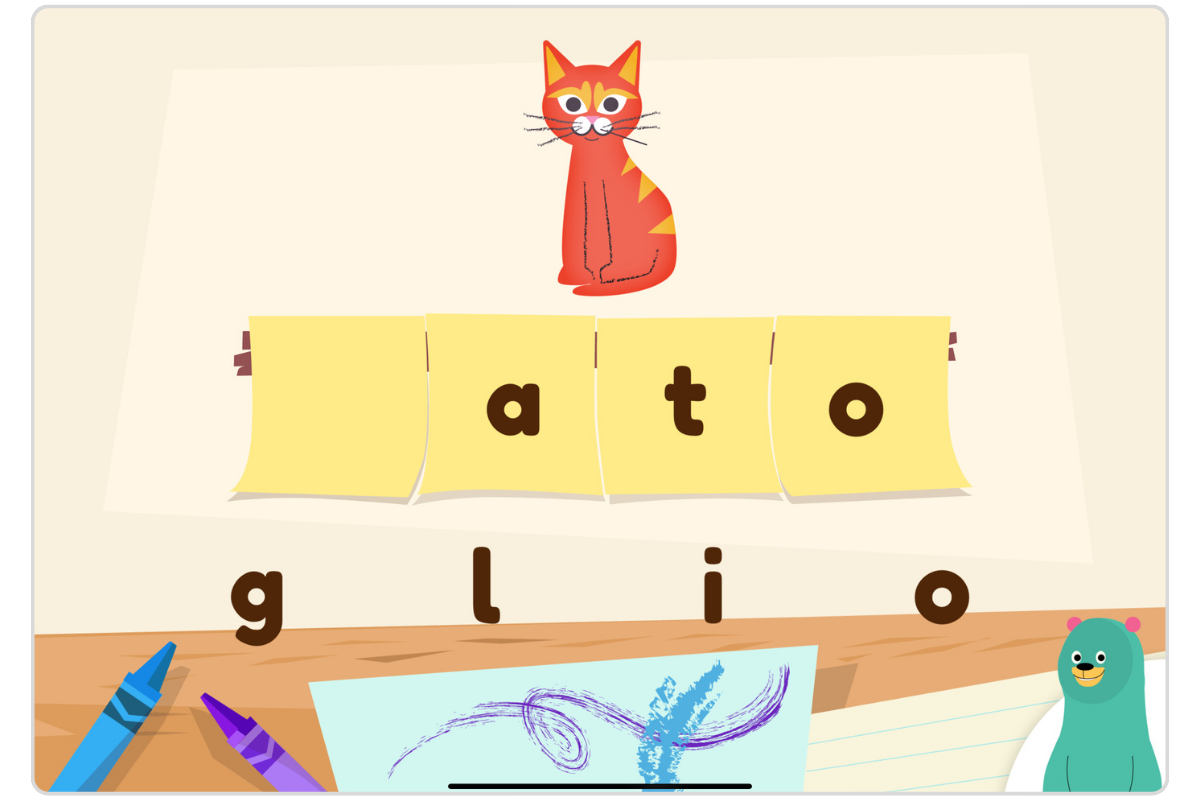
Khan Academy PreK Assessments are short, bilingual (English/Spanish) direct assessments designed to reveal what children know through the kinds of playful, interactive tasks they’re already comfortable with. Each assessment takes about five to seven minutes. Children complete them on a tablet, guided by audio instructions and age-appropriate visuals. No clipboards. No pressure to “catch the moment”.
The product covers four domains: math, literacy, receptive language, and executive function—with assessments available in both English and Spanish. Programs can run assessments three times a year (Fall, Winter, Spring) on an admin-assigned schedule. The same underlying data powers two different reporting views: formative insights for teachers to act on immediately, and benchmark-style summaries for leaders to use for program reporting and resource decisions.
A few things we’re especially proud of:
- It was designed for this age group.
A lot of direct assessments for young children feel like mini standardized tests: sit still, listen carefully, respond on command. That’s not developmentally appropriate for three- and four-year-olds, and the data reflects it. We built our assessments from the ground up using the same design principles we apply to learning activities: playful, engaging, designed for young children to actually succeed.
In our pilot, 100% of teachers reported that children enjoyed and had fun during the assessments.
- It reduces burden without sacrificing quality.
Five- to seven-minute, child-led checks replace hours of observation documentation. Because children are demonstrating skills directly—not being rated by an adult based on observation—results are more consistent across classrooms and sites, and less subject to rater variability. - It’s bilingual by design, not by translation.
Both English and Spanish versions were developed together from the start. For dual language learners (DLLs), that means a truer picture of what children know, assessed in the language where they have the strongest foundation. This isn’t a translation layer—it’s a parallel experience built for the way DLLs actually learn.
- It works alongside existing requirements, not against them.
We know most programs aren’t replacing their existing systems anytime soon. Our assessments are designed as a complementary direct-assessment layer that strengthens the data picture alongside observational tools, and our crosswalk documentation helps programs connect Khan Academy data to common frameworks like TS GOLD and DRDP. - It’s flexible enough to be used for formative assessment, interim assessment, or a hybrid of both.
Some programs use Khan Academy PreK Assessments as a weekly formative assessment tied to small-group instruction. Others run them three times a year as benchmark snapshots. Many do both: formative check-ins between windows, with the same underlying data rolling up into administrator reports.

Pilot Results: 1,000+ Students Across 67 Classrooms
We’ve been running this work in partnership with MDRC, one of the nation’s most respected education research organizations, across more than 1,000 students, 67 classrooms, and five states. The feedback from educators has been consistent.
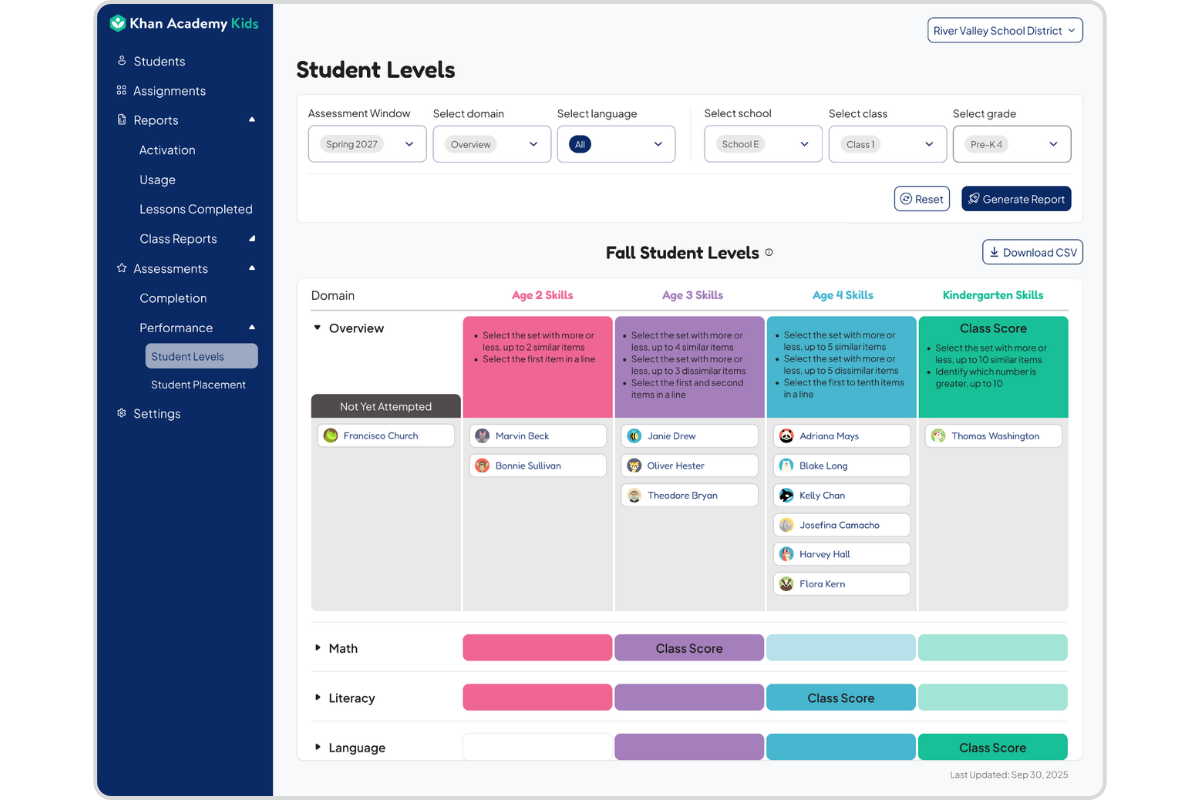
Teachers are using the data to inform small-group instruction in ways that observational tools often don’t enable. Administrators are finding the reporting clear and actionable—87.5% of admins in a survey agreed that reports were visually clear and easy to understand, and that they provided meaningful program-level insights. And kids are completing the assessments—which matters more than it might sound. Higher completion rates mean less missing data, more representative results, and data you can actually trust.
“The Khan tool gives us the exact data we need on where children are at without us having to go through other assessment methods.”
–PreK Pilot Teacher
Free access for publicly funded PreK programs
We believe every publicly funded PreK program should have access to high-quality assessment tools, and cost shouldn’t be the barrier. That’s why Khan Academy PreK Assessments are available free for publicly funded programs during SY 2026–27 and SY 2027–28 as part of our pilot launch.
This is a real, full-featured product, not a limited trial. The free pilot gives programs access to the complete assessment suite, bilingual content, teacher reports, and our administrator dashboard with program-level reporting and completion monitoring. Khan Academy PreK Assessments are one feature within Khan Academy Kids for Schools, and it comes with everything teachers and administrators already love about the platform. That includes 4,000+ learning activities for PreK through Grade 2, a web-based dashboard where teachers can assign lessons outside the app and admins can review class and district-level engagement, dedicated professional development, and a success manager to make sure your implementation is pain-free.
Sign Up for Free Pilot Access (SY 2026–27 & 2027–28)
If your program serves publicly funded PreK students and you’re curious about what this could look like in your classrooms, we’d love to connect.
Frequently Asked Questions
What is a direct assessment for PreK?
A direct assessment is one where the child demonstrates skills themselves — usually by responding to prompts on a tablet — rather than being rated by an adult observer. Unlike observational tools, direct assessments capture what a child actually knows in a standardized moment, which reduces rater bias and produces more consistent data across classrooms.
How is Khan Academy PreK Assessment different from TS GOLD or DRDP?
TS GOLD, DRDP, and COR Advantage are observational tools; teachers watch children over weeks and rate them based on what they see. Khan Academy PreK Assessments are more straightforward: children complete short, playful tasks on a tablet, guided by audio instructions. Each takes 5-7 minutes. The two approaches are designed to work together, and we provide crosswalk documentation that maps Khan Academy data to TS GOLD and DRDP frameworks.
How long does a Khan Academy PreK Assessment take?
About 5-7 minutes per child. Children complete assessments on a tablet, guided by audio instructions and age-appropriate visuals. Programs decide how often to administer them based on their assessment approach — whether that’s three benchmark windows a year (Fall, Winter, Spring), more frequent formative check-ins, or a hybrid schedule set by the program administrator.
What domains does it assess?
Khan Academy PreK Assessments currently cover four domains: math, literacy, receptive language, and executive function. All assessments are available in both English and Spanish.
Does Khan Academy PreK Assessment measure kindergarten readiness?
Yes. While not an official Kindergarten Readiness Assessment, Khan Academy PreK Assessments cover the foundational math, literacy, receptive language, and executive function skills associated with kindergarten readiness. The Fall, Winter, and Spring assessment windows let programs track each child’s progress toward readiness across the year, and administrator reports surface program-level patterns to inform instruction and resource decisions.
Is it available in Spanish?
Yes. English and Spanish versions were developed in parallel from the start, not translated after the fact. For dual language learners, this means assessment in the language where they have the strongest foundation.
Who is eligible for the free pilot?
Publicly funded PreK programs — including Head Start, state-funded pre-K, and district PreK programs — can access Khan Academy PreK Assessments free during SY 2026–27 and SY 2027–28.
Is this a limited trial or the full product?
It’s the full product. The free pilot includes the complete assessment suite, bilingual content, teacher reports, the web-based administrator dashboard, dedicated professional development, and a success manager for implementation support.
Does it replace my current assessment system?
No. But it does replace 26 objectives with minimal teacher involvement making assessment data easier to gather and more reliable! Khan Academy PreK Assessments are designed as a complementary direct-assessment layer alongside observational tools like TS GOLD and DRDP. Most programs use both; observation for ongoing context, direct assessment for more precise data that is comparable across benchmark windows.
What ages are the assessments designed for?
Children ages 3–5 (PreK). The assessments were built using the same design principles as Khan Academy Kids learning activities: playful, engaging, and developmentally appropriate for young children.
What’s included in Khan Academy Kids for Schools?
PreK Assessments are just one feature within Khan Academy Kids for Schools. The platform also includes 4,000+ learning activities for PreK through Grade 2, a web-based dashboard for assigning lessons, class- and district-level engagement reporting, professional development, and a success manager.
How do I sign up?
If your program serves publicly funded PreK students, you can sign up for free pilot access here. We’ll follow up to learn about your program and walk through implementation.
References
Lambert, R. G., Kim, D. H., & Burts, D. C. (2015). The measurement properties of the Teaching Strategies GOLD® assessment system. Early Childhood Research Quarterly, 33, 49–63. https://doi.org/10.1016/j.ecresq.2015.04.005
Miller-Bains, K. L., Russo, J. M., Williford, A. P., DeCoster, J., & Cottone, E. A. (2017). Examining the validity of a multidimensional performance-based assessment at kindergarten entry. AERA Open, 3(2). https://doi.org/10.1177/2332858417706969
Mashburn, A. J., & Henry, G. T. (2004). Assessing school readiness: Validity and bias in preschool and kindergarten teachers’ ratings. Educational Measurement: Issues and Practice, 23(4), 16–30. https://doi.org/10.1111/j.1745-3992.2004.tb00165.x
Kim, D. H., Lambert, R. G., & Burts, D. C. (2013). Evidence of the validity of Teaching Strategies GOLD® assessment tool for English language learners and children with disabilities. Early Education and Development, 24(4), 574–595. https://doi.org/10.1080/10409289.2012.701500
Kim, D. H., Lambert, R. G., Durham, S., & Burts, D. C. (2018). Examining the validity of GOLD® with 4-year-old dual language learners. Early Education and Development, 29(4). https://doi.org/10.1080/10409289.2018.1460125
Waterman, C., McDermott, P. A., Fantuzzo, J. W., & Gadsden, V. L. (2012). The matter of assessor variance in early childhood education — error, reliability, and decision making. Applied Measurement in Education, 25(1), 53–76.