
When Hanover’s Assistant Superintendent Phil Misecko talks about Khan Academy’s pilot in Hanover Community School Corporation, he does not start with the technology. He starts with the students.
“Our high school kids were excited about competing,” he said in a recent webinar. “Teachers were hearing kids tell other kids, ‘Hey, you better pull your weight. I want to win this Gem competition.’ There’s nothing better than positive reinforcement and motivation among kids.”
For district leaders like Misecko, that was an important signal. Students were practicing, tracking their progress, and encouraging each other to keep going. Khan Academy was not just being used. It was becoming part of the school culture.
Khan Academy was not just being used. It was becoming part of the school culture.
This is what our pilot districts helped shape: a Khan Academy experience built around the realities of classroom practice.
District leaders do not need one more tool fighting for time in the school day. They need something that fits the way classrooms already work, giving teachers clearer insight and students more chances to practice, get help, and keep going.
As Khan Academy’s CEO and founder, Sal Khan, said in the same webinar, “For any superintendents listening, if you’re not seeing it yet, it’s because you’re not a pilot district. This new Khan Academy is going to be rolling out to all districts and teachers this summer.”
This rollout reflects more than a year of work with districts, teachers, and students. Together, they helped us understand what supported practice with AI should look like in real classrooms: simple to use, grounded in instruction, visible to teachers, and motivating for students.
Why we went back to the classroom
Our first version of integrating AI into Khan Academy, which launched in March 2023, taught us a lot. Then in January 2025, we took a hard look at our data and made a decision: rebuild Khan Academy and Khanmigo from the ground up.
The goal was not to build AI because AI is exciting. The goal was to help students learn.
As Sal Khan said, “Our primary objective at Khan Academy is that we want to improve academic outcomes as measured by interim assessments, summative test scores. That’s our number one goal.”
By the 2025–26 school year, we were piloting the reimagined Khan Academy with about 5,100 students across five U.S. districts. Pilot partners included Taft ISD in rural Texas and Hanover Community School Corporation in Indiana.
Those districts were not beta testers. They were co-builders.
Their classrooms helped us see what students, teachers, and district leaders needed most: practice aligned to classroom instruction, help when students got stuck, simple ways for teachers to assign and monitor work, and enough visibility for districts to see whether practice was becoming consistent over time.
Three lessons shaped the reimagined experience.
1. AI tutoring should be built into practice, not separate from it.
In the first year after we launched Khanmigo, one thing quickly became clear: Khanmigo could not feel like a separate AI tool students had to remember to open.
If students had to stop what they were doing and start a separate chat to ask for help, many would keep guessing, stall out, or stop practicing.
So we redesigned Khanmigo to be part of the practice itself.
Khanmigo needed to show up when students were already working—when they were stuck, when they made a mistake, or when they needed help understanding what to try next. It also needed to support students without taking over.
One of the earliest guardrails we imposed when creating Khanmigo was that it should not give students the answer. That rule came from the right place. We wanted students to think, try, reason, and work through productive struggle.
But students in classrooms helped us see that the rule needed more nuance.
We realized that before a student submits an answer Khanmigo should encourage the attempt and offer gentle hints. After a student gets something wrong, support can be more direct. In that moment, it may be more helpful for Khanmigo to walk through the work, explain what happened, and help the student recover before the mistake becomes a repeated practice.
Phil described the problem clearly: “When kids would go home and practice math wrong, it took seven times the effort to erase that bad practice and reteach them … With Khanmigo, kids don’t practice math wrong. It doesn’t allow them to do so. It’s a personal tutor that takes that journey with them.”
“I think the reimagined platform is the epitome of student agency. The platform engages students in a way where they feel they are in control of their learning.”
Dr. Juan Vila, Academic Dean at Christopher Columbus High School
Dr. Juan Vila, Academic Dean at Christopher Columbus High School, agrees. “I think the reimagined platform is the epitome of student agency,” he said. “The platform engages students in a way where they feel they are in control of their learning. And the AI is there, not invasive, if the student needs it for support.”
For districts, that kind of design is essential. AI only makes sense if support becomes part of the learning routine, not another place students have to go or another system teachers have to manage.
2. Educators need data they can act on quickly.
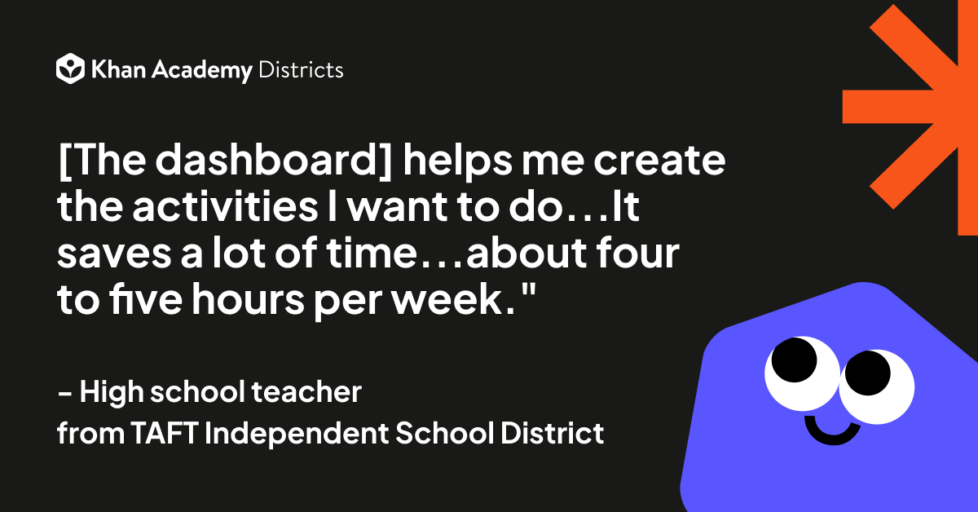
Teachers and admins have made it clear that more data is not always better. What they need is data they can understand quickly and use right away.
In the pilots, teachers did not want to piece together scattered information about who had practiced, who was stuck, which skills needed attention, or whether students were keeping up with weekly work.
They needed a dashboard to answer practical classroom questions, such as: Who needs help today? Which class is on track? Which students are falling behind? What should I do next?
For admins, they needed a dashboard so they could see trends across teachers, schools, and classrooms; identify where implementation was strong or uneven; and pinpoint the areas where support or coaching could make the biggest difference.
In the redesigned Khan Academy, the teacher and admin dashboards help educators move from scattered information to clearer next steps. They can focus by week, teacher, school, class, or student. They can see patterns in usage and progress. And they can use that information to adjust instruction before a gap grows.
“I like how the dashboards let you focus by week, by teacher, by class—and you can see the correlation on who’s using it most,” said Christopher Columbus High School Dean of Data Analytics Mercy Acart. “I can go to that target teacher and ask them to share best practices. How are you getting 80% or 90% of your students to use Khan Academy? It’s better to hear it from a peer teacher than from an admin who isn’t using the program.”
That kind of visibility helps teachers decide whether to reteach a concept, pull a small group, assign more practice, or move forward. It also helps school and district leaders see where strong routines are taking hold and how those practices can spread.
The pilots reinforced a core belief: AI should support teacher judgment, not replace it. Khanmigo can help students during those moments when the teacher cannot be beside every learner at once. The dashboard helps teachers see where their attention is most needed.
For district leaders, this is the difference between a tool that produces reports and a tool that supports instruction. Teachers stay in the driver’s seat—they just get clearer signals, faster.
3. Students stay on track when the path is visible.
The pilots also showed us that access to practice is not the same as completing practice.
Students need to know what to do, when it is due, how much progress they have made, and why it is worth continuing. Without that structure, even strong learning resources can feel like a long list of options. With it, practice becomes a path students can follow.
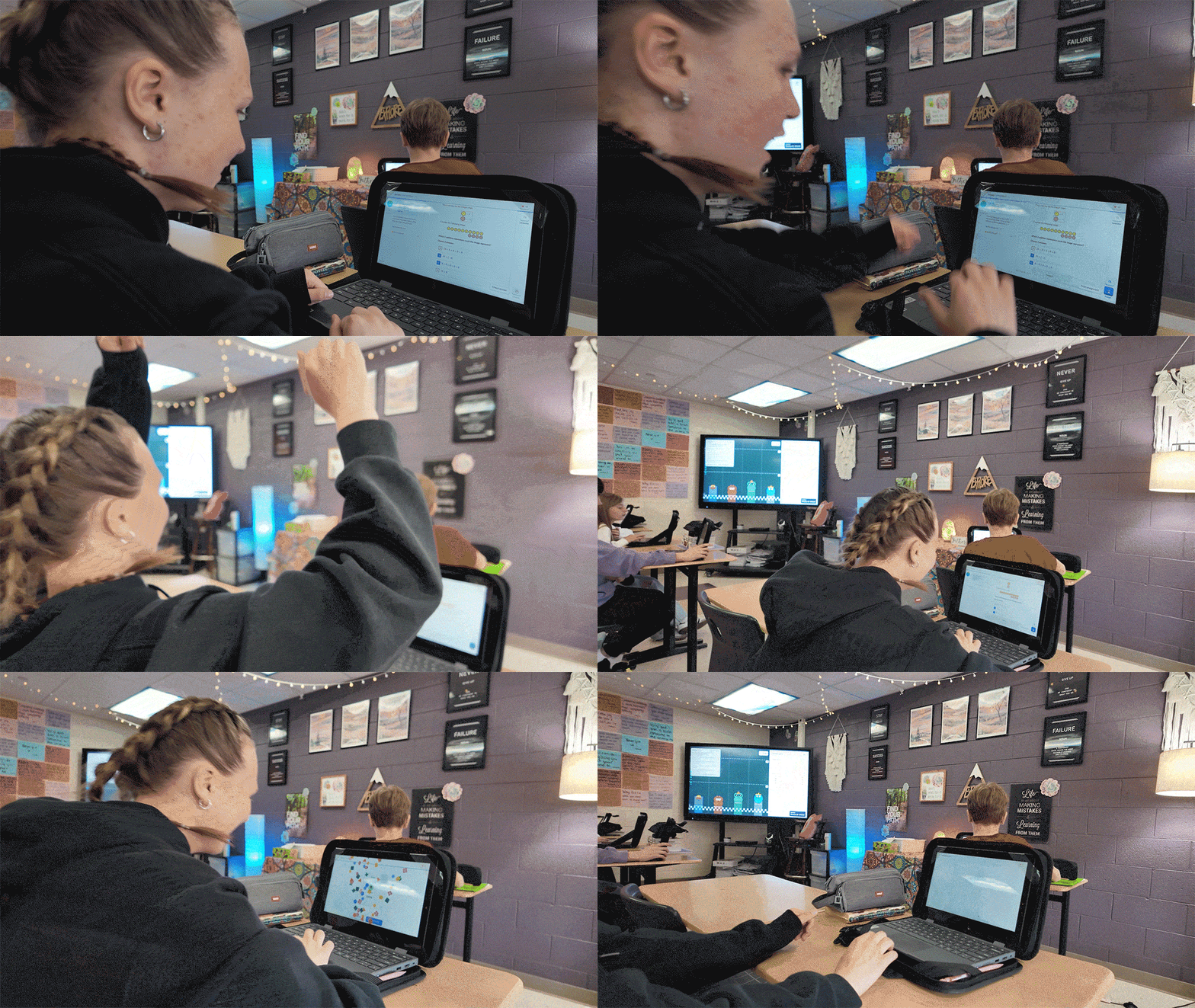
That is why the reimagined Khan Academy gives students a clearer learning path. Students can see their assignments in an organized queue, know what is due, and understand what comes next. Progress indicators, completion moments, Gems, confetti, and classroom rewards give students visible signs that their effort is adding up.
One Taft student plainly described the value of that organization: “I like the fact that [the learning path] is pretty easy to use. It gives you steps in order to complete a weekly assignment and it shows all the assignments. It’s so organized.”
Another student talked about the motivation layer: “I like the confetti at the end and that it says ‘complete.’ It makes me feel special. It makes me excited to use it. It’s encouraging.”
Gems, confetti, and rewards are not the whole point. Learning is the point. But motivation helps students keep practicing long enough to build mastery.
For teachers and districts, that structure makes practice easier to assign, monitor, and sustain. Students know where they are going. Teachers can see their progress. District leaders can see whether the routine is taking hold.
What comes next
The pilots reminded us that every district is different, and what matters most is whether teachers can see value in their own classrooms.
A junior high ELA teacher at Taft ISD put it this way: “I know not all students are at the same level; kids fall through the cracks. I have to move on with my regular curriculum, so knowing I can go back and hit those target skills makes me feel better. I know they’re getting it and I don’t have to stop and reteach.”
Phil described how confidence can spread. “You have to find teachers who are not afraid of AI. Get some of those teachers to use it, you see the results, and they start sharing.” Phil says when scores go up other teachers will ask how they accomplished that. “And that starts growing and moving across the district,” he said.
This summer, every Khan Academy district partner will get access to the experience pilot districts helped shape. It includes clearer learning paths, proactive Khanmigo support, redesigned teacher and admin dashboards, and classroom rewards that help students stay motivated.
The safety, moderation, and content quality that districts expect from Khan Academy remains central. What is changing is how these pieces work together—students know what to do next, Khanmigo supports them when they get stuck, teachers can act on progress data, and districts can see whether practice is becoming part of the learning routine.
District students using Khan Academy are six times more likely to reach recommended practice levels than independent learners. Practice is not the whole story of learning. Teachers, curriculum, relationships, and school context all play a role. But consistent, supported practice gives students more chances to build mastery over time.
“Khan Academy Reimagined is different from any other tool,” said Christina Insua, Dean of Faculty at Christopher Columbus High School. “Some tools focus on practice problems, others on videos. But the best part about Khan Academy Reimagined is that it brings everything together. You have the videos, the questions, [the] Khanmigo AI tools—everything in one trusted spot that students and teachers can use to personalize learning.”
The pilots were a collaborative effort between us and all the educators, students, and leaders who helped shape what Khan Academy is becoming.
This is how we believe AI for education should be built—with classrooms, with evidence, and with teachers and students at the center.
Get a free demoIf your district is exploring how to make practice more consistent, give teachers clearer insight, and use AI in a way that safely supports learning, the reimagined Khan Academy was built with those goals in mind. Visit khanacademy.org/schools to see a demo.