By Dr. Kristen DiCerbo, Chief Learning Officer, Khan Academy
Last quarter’s piece urged school leaders to name the problem to be solved before you select ed tech tools. This quarter, I want to explore one specific, very common problem: students do not get enough individual practice.
Repetition through practice is the mechanism by which learning becomes durable. New neural connections are weak and unreliable at first. Without repeated use and feedback, they fade. With it, they strengthen. Human memory changes only through repeated activation — not through clever delivery, not through engagement alone. A Carnegie Mellon study spanning 1.3 million observations across nearly 7,000 students found that each additional practice opportunity produces a similar, predictable increase in a student’s odds of getting the next problem right, regardless of where that student started. And yet in most classrooms, students complete too few practice problems, receive thin feedback, and move on before they’ve demonstrated mastery.
Practice does not have to mean rote drilling; it is active learning. It is the process of retrieving, explaining, testing, receiving feedback, and revising, and, critically, applying that knowledge in contexts that vary. Mastery requires repeated opportunities in varied tasks, not repeated exposure to the same problem.
Nor should practice stop at procedural skills. Schools routinely say they want students to graduate with strong critical thinking, collaboration, creativity, and communication — the “4Cs.” These skills get invoked to justify everything from project-based learning to technology purchases. And yet, in most schools, the skills are assumed rather than taught and practiced explicitly (with support and feedback). Communication and critical thinking develop the same way fluency in math does: through explicit instruction, practice in authentic contexts, and feedback. Collaboration does not develop because students were placed in a group; it develops because it was coached, practiced, and corrected.
Of course one difficulty with practice is that it is nearly impossible for one teacher to give individualized support and feedback to every student in a class appropriately timed based on their needs. This is a key place where education technology and AI can help.
If your students are not achieving at the levels you would hope, ask whether they have enough quality individual practice.
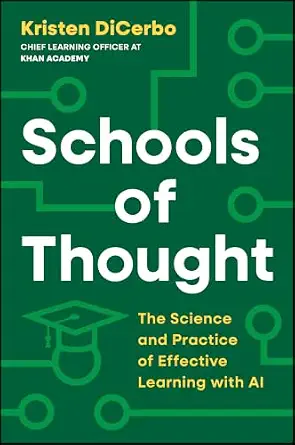
I talk much more about this and how AI can support this practice in my book, Schools of Thought: The science and practice of effective learning with AI, which is coming out in March, 2027. It is available for pre-order now on Amazon, Barnes and Noble, and Bookshop.org.
Learn more about Khan Academy’s work with districts at khanacademy.org/schools