
Schools have more student data than ever before. Benchmark scores. State assessment results. Classroom assessments. Attendance data. Intervention data. Learning-platform data. But having more data doesn’t necessarily mean that teachers know what to do next or that student outcomes improve.
This is an important distinction when districts evaluate progress-monitoring tools. The goal shouldn’t just be to measure student performance three times a year. Instead, a powerful assessment system should help educators answer three questions:
- Where is this student now?
- Why are they struggling?
- What should happen next?
If an assessment only answers the first question, much of the assessment’s potential is lost. In this blog, we will cover assessing what matters, why an assessment should provide more than just a score, how an assessment can turn testing into learning and growth, and how assessments should serve the needs of administrators, teachers, and students.
An assessment system should improve learning, not just monitor it. This new school year, as district and school administrators plan for progress monitoring and research all the assessment options available, they should ask six important questions.
Is my assessment system measuring what matters effectively and efficiently?
A useful progress-monitoring assessment should provide a reliable answer to a straightforward question: how is a student progressing toward grade-level success? Anything that adds testing time without answering that question deserves scrutiny.
Every minute students spend taking an assessment is a minute they aren’t learning. That doesn’t mean assessments should simply be shorter. It means every assessment item should earn its place on the test.
Adaptive assessments can help. Instead of giving every student the same fixed set of items, an adaptive assessment adjusts in real time based on the student’s responses. This allows an assessment to offer targeted data about individual students’ performance without requiring every student to respond to the same long series of items that may be too easy or difficult for them.
But efficiency isn’t only about test length. An assessment should also measure the knowledge and skills educators actually care about, including how students are performing against grade-level expectations and whether that performance is changing over time.
Does my assessment system reveal more than whether an answer was right or wrong?
Traditional assessment items are very good at telling us what answer a student selected. They are much less effective at telling us why the student selected the answer.
For example, three students choose the same incorrect response to a math problem. One student has a deep conceptual misunderstanding. Another student understands the concept but made a calculation error. A third student just guessed.
Assessment scores treat the three students exactly the same, but instruction shouldn’t. That’s why the next generation of assessments should find ways to make student thinking visible.
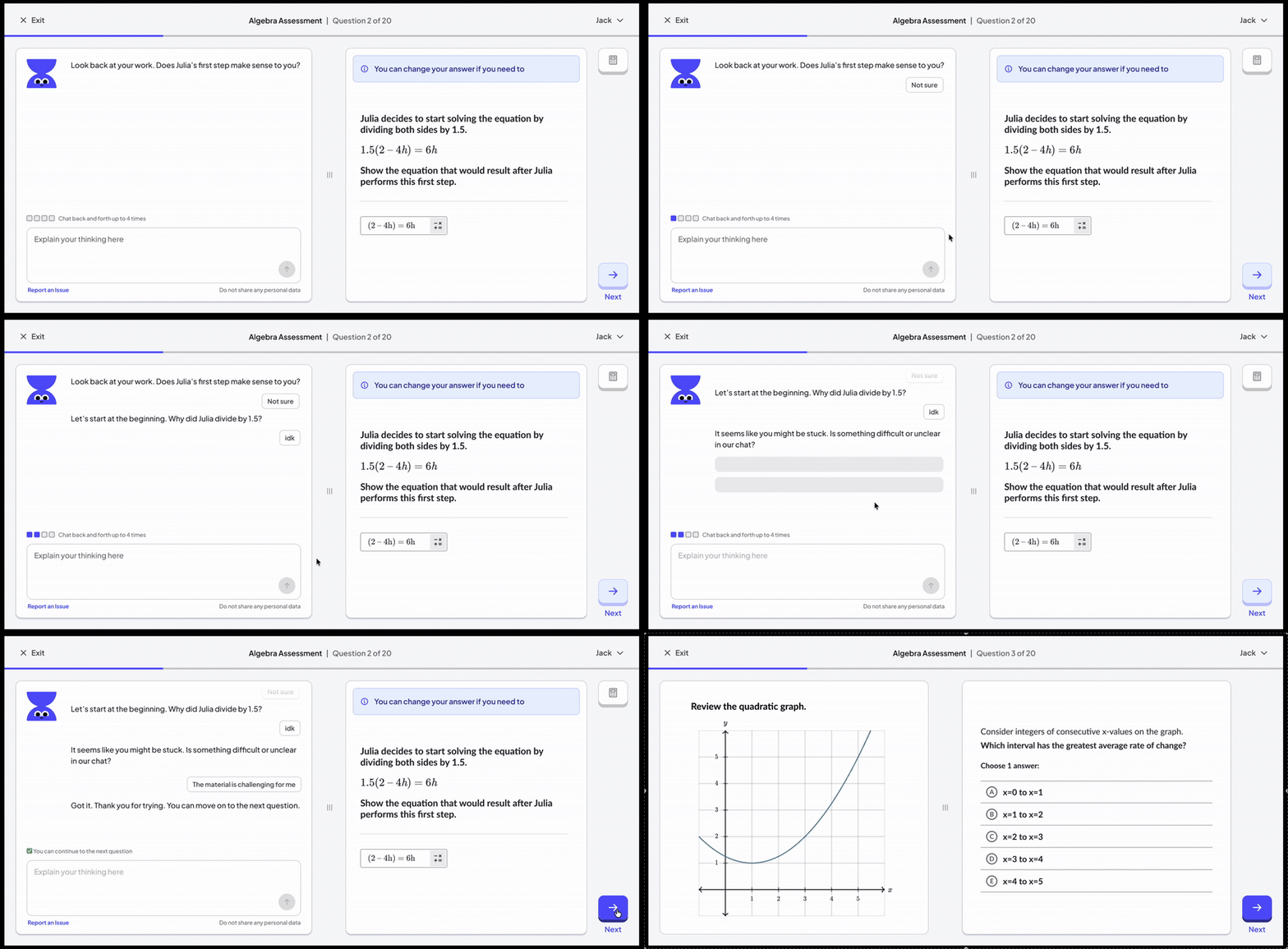
At Khan Academy, we’re learning about student thinking through Explain Your Thinking, an AI-enhanced assessment experience that asks students to explain their reasoning. After answering a typical question during an assessment, something new happens: an AI conversation window appears beside the question and a student is prompted to converse about their thinking.
The initial prompts were developed with our math and ELA subject matter experts and built into the conversation. There is a short-back-and forth exchange with the student; if the student explains their thinking well enough to satisfy the underlying rubric, the conversation ends. If the student doesn’t explain their thinking clearly enough, the conversation continues with another question that either digs deeper or reframes. Instead of only seeing the answer a student gave, we can see how they arrived at the answer.
This matters even more in an AI-enabled world. Finding an answer is becoming easier. Being able to reason about an answer, explain it, and demonstrate genuine understanding is becoming more important.
Does my assessment system turn results into something students can actually do?
This may be the biggest missed opportunity in assessment. A student takes an interim assessment. A report is generated. Teachers analyze the results. Perhaps students are grouped for intervention or teachers adjust upcoming instruction.
If an assessment identifies skills or concepts in which a student needs support, the assessment data should help determine what the student works on next. Khan Academy Interim Assessments are being designed around that principle. Assessment results inform personalized learning paths in Khan Academy content, prioritizing grade-level learning while providing scaffolding and foundational support when students need it.
That creates a much tighter cycle:
Assess → understand what students need → personalized learning path → grow → assess again.
Assessment isn’t just about measurement. Instead, it’s the beginning of the next learning experience.
Does my assessment system turn results into something students can actually do?
A superintendent and a classroom teacher don’t need the same report:
- District leaders need to understand patterns across schools and student populations.
- School leaders need to identify grade-level and classroom trends.
- Teachers need to know which students need support and what concepts may require reteaching.
- Students need information they can understand and act on, which builds agency.
A strong assessment system shouldn’t simply provide more data. Instead, it should produce the right information for each role to support the decision they are trying to make.
Does my assessment system just measure growth, or does it help create it?
Interim assessments are typically administered at multiple points during the school year for a reason. Educators don’t just need a snapshot. They need to know whether students are continuing to learn. That makes growth an essential part of an effective assessment system. A beginning-of-the-year result establishes a student’s starting point. Subsequent assessments illuminate whether instruction and intervention are producing meaningful progress.
But there’s an important distinction here. Measuring growth isn’t the same thing as causing growth. An assessment can tell us whether a student has made progress, which is useful information. The larger opportunity is to build assessment and instruction into the same continuous improvement cycle.
Imagine an assessment system in which educators can identify a need, understand more about the student’s thinking, connect that student with appropriate learning experiences, and then measure whether those experiences helped. That’s when assessment goes beyond measurement and becomes part of learning.
When assessment becomes part of the learning process
When evaluating an interim assessment, it’s natural to compare test length, item banks, standards alignment, scores, reports, and technical specifications. But there is a fundamental question districts can ask when planning for interim assessments: What happens differently for a student because they took this assessment?
If the answer is just “We know their score,” the assessment has done its measurement job. If the answer is “We understand more about what they know, how they’re thinking, and what they need next—and we can connect them directly to learning that addresses those needs,” then the assessment is doing something more powerful.
Great assessments should turn evidence of learning into more learning. That’s the opportunity for the next generation of assessments: measuring progress, yes, but also helping create it.
Move from measuring progress to accelerating it
Khan Academy Interim Assessments help districts uncover what students need, understand how they’re thinking, and connect every learner to personalized support.
Learn more