By Megan Colburn, Marketing Lead, Khan Academy Kids
If you’re evaluating PreK assessment tools for your program—or trying to understand what a high-quality preschool assessment should actually cover—you’re navigating a market that ranges from clipboard-based observation systems to tablet-delivered direct assessments, each with different tradeoffs in accuracy, burden, and usability.
This post breaks down what a preschool assessment typically includes, how the most common approaches differ, and why an increasing number of publicly funded PreK programs are turning to play-based PreK assessment as a more accurate, lower-burden alternative.
What domains does a preschool assessment cover?
Preschool assessments measure children’s development across multiple domains. While specific tools vary in their coverage, most research-aligned PreK assessments address some combination of the following:
- Early literacy — phonological awareness, letter recognition, print concepts, and early reading skills that predict kindergarten readiness
- Early math — counting, number sense, patterns, shapes, measurement, and foundational operations
- Language development — receptive language (understanding instructions and vocabulary) and expressive language (how children communicate)
- Executive function — attention, working memory, cognitive flexibility, and self-regulation, which are strong predictors of school success across all subjects
- Social-emotional development — relationship skills, self-awareness, and responsible decision-making (typically assessed through observation rather than direct tasks)
- Physical development — fine and gross motor skills, often captured through teacher observation or structured tasks
Not every preschool assessment tool covers all of these domains equally.
Some tools are comprehensive by design; others focus narrowly on literacy and math as the strongest predictors of kindergarten readiness. Which domains matter most for your program depends on your reporting requirements, your student population, and how you intend to use the data.
How are preschool assessments administered?
There are two primary approaches to PreK assessment, and most programs use some combination of both.
- Observational assessment
Teachers document children’s skills through anecdotal notes, photos, work samples, and behavioral checklists gathered over time. Tools like TS GOLD, DRDP, COR Advantage, and Work Sampling System are built on this model. They’re deeply embedded in Head Start requirements and state funding systems, and they can capture a broad picture of the whole child. The tradeoff: they require significant teacher time, produce data that varies based on who’s observing and what moments happen to occur, and can underrepresent children whose skills don’t show up in easily “capturable” moments—including many dual language learners. - Direct assessment
Children demonstrate skills directly through structured tasks, either administered by a teacher or completed independently on a device. Direct PreK assessment tools tend to produce more consistent, comparable data across classrooms and are less subject to rater bias. The tradeoff: poorly designed direct assessments can feel like mini standardized tests, which isn’t developmentally appropriate for three- and four-year-olds and can produce unreliable results if children disengage.
Play-based assessment is an approach to direct assessment that resolves this tension. Rather than asking young children to sit still for a formal test, play-based PreK assessment tools present structured tasks through short, engaging, age-appropriate interactions—activities that feel like play to the child but generate scorable, reliable data for educators and administrators.
Why many programs are adding play-based PreK assessment
For most preschool programs, the question isn’t whether to use observational assessment—compliance requirements often make that decision for them. The question is whether observational data alone is sufficient, and for a growing number of program leaders, the answer is no.
Teachers are spending more time documenting than teaching. Evidence-gathering becomes a scramble at the end of each marking period. And when data quality depends on who was observing, what moments happened to occur, and how much time teachers had to write it up, the resulting picture is inconsistent at best.
Some children are particularly underrepresented in observational data: dual language learners whose skills are strongest in a language other than English, quieter children who demonstrate knowledge in less visible ways, and children in classrooms where teachers are stretched thin and documentation suffers.
Play-based PreK assessment offers a direct-assessment layer that produces more consistent, comparable data—not to replace observational systems, but to strengthen the overall picture with evidence that doesn’t depend on teacher inference.
What play-based PreK assessment looks like in practice
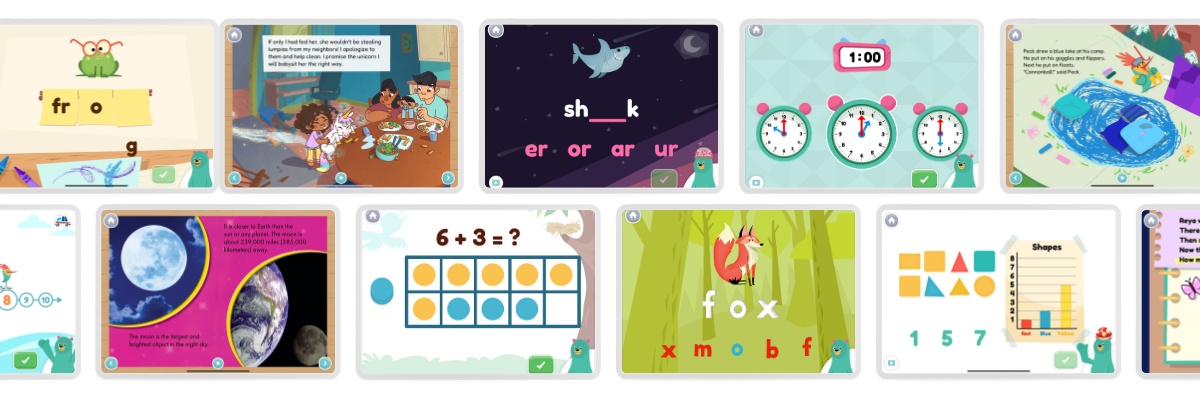
Khan Academy PreK Assessments are built on this model. Each assessment takes about five minutes. Children complete tasks independently on a tablet, guided by audio instructions and developmentally appropriate visuals. No clipboards. No “catching the moment.” No teacher needing to be in three places at once.
The tool covers four core domains: math, literacy, receptive language, and executive function—approximately 56 assessments in total, available in both English and Spanish. Programs run assessments three times a year on an admin-assigned Fall/Winter/Spring schedule.
A few things that set this play-based PreK assessment apart:
- Designed for early learners, not scaled down from older grades.
Many direct PreK assessment tools are built like junior versions of K–12 tests—sit still, listen carefully, respond on command. That’s not developmentally appropriate for three- and four-year-olds. Khan Academy PreK Assessments were built from the ground up using the same design principles that power our learning activities: playful, engaging, and designed so young children can show what they actually know. In our MDRC-validated pilot, 100% of teachers reported that children enjoyed and had fun during assessments. - More consistent data, less rater variability.
Because children demonstrate skills directly rather than being rated through observation, results are more comparable across classrooms and sites. A child’s score doesn’t depend on whether their teacher had time to observe them that week. - Bilingual by design, not by translation. English and Spanish versions were developed in parallel from the start—not retrofitted. For dual language learners, this means a more accurate picture of what children know, assessed in the language where they have the strongest foundation.
- One dataset, two reporting views. The same assessment data powers teacher-facing formative reports for instructional planning and administrator-facing program summaries for compliance reporting and resource decisions. It’s not “one more thing”—it’s a smarter use of the data already being collected.
- Works alongside existing compliance requirements. Most programs aren’t replacing TS GOLD or DRDP anytime soon, and they shouldn’t have to. Khan Academy PreK Assessments are designed as a direct-assessment complement to observational systems, with crosswalk documentation to help connect data to common frameworks.
What the research shows
Khan Academy PreK Assessments have been piloted in partnership with MDRC—one of the nation’s most respected education research organizations—across more than 1,000 students, 67 classrooms, and five states.
Early results are encouraging:
- 87.5% of administrators agreed that assessment reports were visually clear and easy to understand
- 87.5% agreed that reports provided meaningful, comparative program-level insights
- Teachers consistently reported using the data to drive small-group instructional planning in ways their existing observational tools didn’t support
One pilot teacher described it this way: “The Khan tool gives us the exact data we need on where children are at without us having to go through other assessment methods.”
Data gathered from the pilot has been applied to make assessments psychometrically valid, and a technical manual is expected later this year.
Free PreK assessment access for publicly funded programs
We believe cost shouldn’t determine which programs have access to high-quality PreK assessment data. That’s why Khan Academy PreK Assessments are available free to publicly funded PreK programs for two full school years—SY 2026–27 and SY 2027–28—as part of our initial launch.
This is a complete, full-featured product. The free pilot includes the full assessment suite across all four domains, bilingual English/Spanish content, teacher-facing classroom and student reports, and a web-based administrator dashboard with program-level reporting, completion monitoring, and export capabilities.
Frequently asked questions about preschool assessment
What is included in a preschool assessment? A preschool assessment typically covers early literacy, early math, language development, and executive function. Some tools also include social-emotional development and physical development. Coverage varies by tool—some are comprehensive across all domains, while others focus on the skills most predictive of kindergarten readiness.
What is the difference between observational and direct PreK assessment? Observational assessment relies on teachers documenting children’s skills through notes, photos, and checklists gathered over time. Direct PreK assessment has children demonstrate skills through structured tasks. Play-based PreK assessment is a form of direct assessment designed to be developmentally appropriate through short, engaging, tablet-based activities.
How long does a preschool assessment take? It depends on the tool. Observational assessments accumulate evidence over weeks or months of classroom documentation. Direct PreK assessments like Khan Academy PreK Assessments are designed to take approximately five minutes per assessment, completed independently by the child on a tablet.
Can a direct PreK assessment be used alongside TS GOLD or DRDP? Yes. Direct and play-based PreK assessments are typically designed as a complement to observational systems, not a replacement. Khan Academy PreK Assessments include crosswalk documentation to help programs connect their direct assessment data to TS GOLD and DRDP frameworks.
Is there a bilingual preschool assessment available? Yes. Khan Academy PreK Assessments are available in both English and Spanish, with both versions developed in parallel from the start—not translated after the fact. This makes them a strong option for programs serving dual language learners.
Is there a free PreK assessment tool for publicly funded programs? Yes. Khan Academy PreK Assessments are available at no cost to publicly funded PreK programs for SY 2026–27 and SY 2027–28 as part of a free beta launch.
Ready to bring play-based PreK assessment to your program?
Khan Academy PreK Assessments are one feature within Khan Academy Kids for Schools, which also includes 4,000+ learning activities for PreK through Grade 2, a web-based teacher and admin dashboard, and a eBook library with more than 400 fiction and non-fiction titles—all designed for the programs and children who need it most.